It was an amazing day in Canterbury today. Sunday worship at the cathedral sort of took me by surprise. I wasn't expecting to be so moved and so inspired and so proud to be here and a part of the Anglican tradition where it all began in 597AD. The guest choir from Pusey House Oxford sang mass settings by Palestrina. Just as they launched into the final 'Hosanna in Excelsis' of the Sanctus, a flock of gulls criss-crossed the translucent windows of the nave looking like the shadows of a flock of angels circling the cathedral. As the choir finished, the noon day bells began to ring. Just then, the Archdeacon of Canterbury, the Venerable Sheila Watson, the presider for the day, continued reciting the Eucharistic Prayer, "Accept our praises, heavenly Father, through your son our saviour Jesus Christ..." (Sheila has a great voice, a resonate alto with plummy vowels and sibilant S'es -- she was born to intone the Anglican liturgy!) It was an amazing confluence of music, bells, voices and a flock of seagulls to mark the feast day of St. Mary Magdalene, for perhaps the 1,600th time in this place...
 Another face of Canterbury was met at the reception for the Canterbury Scholars at 'coffee hour' which here is wine and juice hour, really. All the kids in the Sunday Club (aka Sunday School) made cards for each of the Canterbury Scholars, mine featured a lot of glitter (hmmmm, wonder why???) and was inscribed, "To Mark Collins, with love, Plum XOX." I think Plum is what you call 'cheeky' here. Also included in the card was a Dubble 'fair trade' chocolate bar which is on reserve for later this evening.
 I also met a lovely woman named Kate who was telling me about her nearby neighborhood. I mentioned that I was looking to do some sightseeing by bicycle around the area if I could ever find a bike to rent. She said, "Oh, my husband has loads of bikes. He can loan you one."
I met her husband Nick and he loaned me a mountain bike (above left), helmet, gloves, pump, spare tube and tools! Unbelievably generous, especially given the cost of renting here ($24/day, $100/week). So, I have wheels!!! I'm so glad and was able to tool about the town in the afternoon in the same fashion I do in NYC. Very, very glad about that!
This is truly the place where, as Bono sang, 'the streets have no name' so I was having trouble following the cycling map of the city, when I turned a corner off a city street and found this amazing field to cycle through (above). Amazingly beautiful and just around the corner from Canterbury proper. I finally managed to make it around the city on the bike path, so I now have a good 1/2 hour ride I can do on breaks in our schedule. And you see so much of the people and places that make up this place. Haven't cycled through many Norman castles before, but it appears I'll be able to quite often here. I also hope to get out on the roads around Canterbury and cycle up to Whitstable, which is 7 miles away, and maybe even to the beach at Sandwich, which is 15 miles away. A bit ambitious perhaps, but we'll see what the schedule allows.  It's now time for 'Clapham Junction', a Channel 4 drama celebrating the 40th anniversary of the decriminalization of homosexuality in the UK. Then to bed -- the real course work here starts tomorrow.
22 July 2007
Sunday in Canterbury
30 July 2007
Another Sunday in Canterbury...
It was my second Sunday in Canterbury. The day included three services, a self-tour of St. Dunstan's church, singing, a BBQ, and a beautiful sunset. Here are some scenes from the day:
 The Canterbury Scholars are serving as chalcifers for the Sunday 11:00 am Sung Eucharist during our term here. That's Victor from Sri Lanka, me, Gradwell from South Africa, some Welsh guy, and Ron from the USA.
Next was the discovery of the connection between Canterbury and William and Margaret Roper, daughter and son-in-law of Sir Thomas More, and More himself -- at least part of him. Margaret More Roper (famous from CH2 for being learned and lovely) and her husband lived in Canterbury on the high street leading into the city centre. This was their gate.
 In this stained glass window in St. Dunstan's Church, Canterbury More is pictured in the central panel. His devoted second wife Alice kneels at his feet. Margaret is to his right, and her husband William to his left. Margaret was thought to be the most educated woman in Europe in her day. Her humanist father saw that all his children, including his daughters, were educated to the highest standards of the then burgeoning renaissance. It is More's example that likely influenced Henry VIII in his decision to make sure that his daughter Elizabeth was educated to a similar standard.
 Margaret More Roper, after her father's beheading at the Tower of London on 6th July 1535, retrieved his decapitated head and had it buried in the Roper family crypt in St. Dunstan's Church, were she and her family would eventually be buried. Seems grisly, but if my understanding of the practices surrounding Tudor executions is correct, More's body would have been buried immediately after his execution in St. Peter's Ad Vincula, a small church within the gates of the Tower of London. Then his head would have been set upon a pike at the Tower or on London Bridge (or elsewhere) as a warning to others. (More was convicted of treason for refusing to sign the new oath required by parliamentary act acknowledging Henry as the head of the church in England.) Given Henry's reluctance to execute More, and his affection for his family, More's head was probably handed over to Margaret without it going on display, or shortly thereafter. Margaret saw that her father's head was duly interred in Canterbury.
 Later that evening, the cathedral commemorated the feast day of William Wilburforce, a member of parliament and the evangelical wing of the Church of England. Two hundred years ago, thanks largely to the efforts of Wilburforce and his supporters, the Clapham Sect, the slave trade was outlawed in Britain and all its possessions. Wilburforce had wanted to outlaw slavery itself, and initially failed, settling for an end to the trade in slaves. Slavery itself was abolished in the British Empire in 1833-4. The Canterbury Scholars were asked to form an ad hoc choir for the service (the Cathedral Choir is on holiday). We sang, "Go Down Moses", "Steal Away", a Russian "Kyrie", and a hymn written for the anniversary called "Abolition".
 Thereafter, we were treated to a BBQ on the lawn (aka 'back garden') of Canon Ed Condry's home in the cathedral precincts. Pretty nice little place, eh? Definitely worth taking a 7:30am Matins service or two.
 The day ended with yet another of those beautiful English summer sunsets that seem to last and last.
16 November 2007
Canterbury's Thomas # 1: Thomas Becket
Here are some pics from Canterbury that relate to Thomas Beckett, and the attack on his cult and shrine by Henry VIII...
 This is the site of the actual martyrdom in 1170. On this spot, just off the Cathedral Cloister and Chapter House, Thomas Becket was slain by men from the court of Henry II.
 Originally, Thomas Becket was buried in a fairly simple tomb in the crypt of the cathedral. Almost immediately his cult began to develop. This is a detail from one of Canterbury's stained glass windows known as the 'Miracle Window' because it documents some of the miracles associated with Thomas Becket's tomb. What it also documents is what the original tomb in the crypt may have looked like. Notice the holes in the side of the tomb. It's believed that these openings allowed pilgrims to touch Becket's coffin, with their hands, feet, and even their heads, to seek a blessing or cure from the saint.
  Eventually, a magnificent shrine to the saint was built upstairs in the Trinity Chapel at the east end of the cathedral on the spot pictured above. It might have looked something like the photo of Edward the Confessor's shrine in Westminster Abbey below. It is believed that the openings allowing access to the saint's coffin were maintained. It was believed to have been build of rose colored stone and to have become heavily jeweled as pilgrims and patrons made gifts of precious metals and stones to the shrine.
 Edward the Confessor's shrine in Westminster Abbey.
 The shrine stood in the Trinity Chapel from 1220 until 1538 when its destruction was ordered by Henry VIII -- just over 300 years. During those 300 years, the tomb of Thomas Becket was the focus of intense devotion and pilgrimage. It is to the tomb of Thomas Becket at Canterbury that Chaucer's pilgrims are travelling as they tell each other their Canterbury Tales. Here in the floor stones of the Trinity Chapel, you can see where the knees of 300 years of pilgrims have smoothed the rough stone, creating a dip in the stones where they knelt beside the shrine.
  Another view of the floor in the Trinity Chapel where the shrine of Thomas Becket once stood. This shot is taken from the northeast corner of the spot where the shrine once stood. The dip worn by the pilgrims' knees is clearly visible.
 The stone used in the shrine is believed to have been rose colored marble. As the jewels and precious metals on the tomb were harvested for the royal treasury in 1538 -- including the Regale of France, a huge ruby offered to Becket's memory by Louis VII which became a part of a thumb ring worn by Henry VIII, the stone itself was tossed aside. Pieces of rose colored stone believed to have been part of the shrine are still found from time to time at the cathedral when excavations and renovations are made. These two pieces of rose stone are in the cathedral archive.
 Over the course of centuries some of the discarded rose colored stone has been refashioned and used in various structures of the cathedral. This piece of rose colored stone was used to pave the cathedral cloister.
 Thomas Becket's memory is still honored today by priests and publicans in Canterbury.
04 October 2007
Canterbury Wrap-up
.JPG) This is the entire group of Canterbury Scholars in the garden of St. Andrew's House, the home of the Anglican Communion Office. We met the Rev. Ken Kearon, Secretary General of the Anglican Communion and some of his staff. We also gave presentations on aspects of the life of the communion that were important to us. We had a great lunch and then a barge ride down the Thames to Greenwich, then back on the bus to Canterbury.
This is the entire group of Canterbury Scholars in the garden of St. Andrew's House, the home of the Anglican Communion Office. We met the Rev. Ken Kearon, Secretary General of the Anglican Communion and some of his staff. We also gave presentations on aspects of the life of the communion that were important to us. We had a great lunch and then a barge ride down the Thames to Greenwich, then back on the bus to Canterbury.

It was a long day -- Gabriel and Mark enjoy a little shut-eye on the cruise down the River Thames


This is the pulpit in St. Mary's Church, Bishopsbourne, Kent. Richard Hooker was the rector of St. Mary's and in its rectory completed Of the Laws of Ecclesiastical Polity, the 16th century masterwork of Anglican Via Media. Hooker left a provision in his will that this pulpit for the church was to be provided as his legacy.


St. Mary's must have enjoyed the favor of the late Victorians. Also in the church is this amazing Edward Burne-Jones window and an even more amazing William Morris reredos.
St. Mary's moved some of us to sing and dance. My fellow scholars from all around Africa sang the song that the Martyrs of Uganda sang as they were led to their martyrdoms in 1885-1887 & 1977. We sang the song again as the sequence hymn the next day at the 11:00 A.M. Holy Eucharist in Canterbury Cathedral.

The last Sunday was for a final Holy Eucharist in the Cathedral and a garden party in our honor... then good-byes.
20 July 2007
Canterbury at first glance
 I'm finally here in Canterbury after trains, planes, automobiles and 'coaches'. This is a shot of the view from my room in the Canterbury Cathedral International Study Center. I'll be here for not quite three weeks with 35 other newly ordained priests and seminarians from throughout the Anglican Communion. So far, I've met folks from the US, Namibia, South Africa, The Seychelles and Zambia -- and that's with only 2/3s of us here. Should be a great time and should be interesting and challenging.
The trip was fine, if quite long. Entered London in yet another torrential downpour -- the UK has had three of four bad rains this year, and today was another. Didn't seem to affect my travel. Got here from London well enough. Took the (much cheaper) bus and got to see all the golden fields of rape that are ubiquitous in Kent.
Am trying to stay awake til at least 10pm tonight so as to reset my jet lagged circadian rhythms. Had a spot of lunch upon arrival (actual cucumber sandwiches (no crust, of course) while seated at a garden table just off the Study Centre refectory. Can't make this stuff up.
Walked around the city centre to avoid taking a nap. Here are some scenes:
 These are the heraldic shields and devices on the gate to the Cathedral Close. A few of my favorites are here: Portcullis, Tudor Rose, Royal Arms...
This is the bank of the River Stour that runs through Canterbury. Lovely, eh? I love the green river grass that lies just beneath the waters surface and makes the river bottom look like a sheet of waving emeralds.

The Crab and Winkle Way: a bike path to Whistable I hope to ride along next weekend.
Heard Evensong this evening in this magnificient, glorious space, sung by the choir of Pusey House at Oxford. It could have been 1607 instead of 2007. It was a thing of great, great beauty -- and they do it 7 days a week -- all to the glory of God.
Time to catch a little British TV and then hit the sack. Days begin with Matins and Eucharist in the mornings and attendance is required. Yikes!
25 July 2007
Crab & Winkle Way
Yes, Virginia. There really is a Crab & Winkle Way and I've been from one end of it to the other, and back again. And I may do it all again tomorrow. 
.
It's 7 miles from Canterbury to Whitstable on the coast, so 15 or so miles round trip
This is what the pathway looks like most of the way. Soft gravel, fields of rape, trees that serve as windbreaks for the fields, but also some woods and a few stretches through Canterbury and Whitstable neighborhoods.
On the bridge over the A290 highway from Canterbury to Whitstable -- and the ubiquitous golden fields of rape.
The 'beach' at Whitstable. Whitstable is an oystering town, and they'd just celebrated the Whitstabel Oyster Festival. Cute fishing village, not overly commercialized, with lots of working class/middle class families on holiday.
 The view from the hill just outside of Canterbury as the clouds parted and the sun shone on the cathedral.
21 July 2007
Blue Sky Day in Kent
 It was a beautiful blue sky day in Kent today. Lots of sun and 'warm' weather. I say warm, but it was at most 70 degrees -- what passes for warm around here.
Day began at matins in the crypt of the cathedral. Then Bible Study in our assigned small groups. In my group are seminarians, deacons and priests from India, Zambia, Namibia, South Africa, New Zealand, Mauritius, Burundi and the US. Our Bible lesson was the Road to Emmaus from Luke. Such a great story to take on here in this place of pilgrimage. And a great story of mission, of journey to consider amongst a group of people who have traveled from so far to be here.
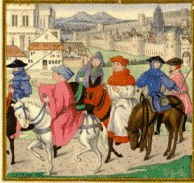
Lunch was followed by some time off. I wandered around the city centre for a bit and then out into Canterbury. Came across another terrific view of the River Stour. The river grass is so beautiful waving at the sun from just below the surface of the water. Passed the inevitable Thomas Beckett pub. Also visited the site of St. Thomas's martyrdom in the cathedral proper. It was Thomas's martyrdom on this spot on 29 December 1170 that helped make Canterbury a focus of pilgrimage. Chaucer's pilgrims were on a pilgrimage to Canterbury telling stories to pass the time -- and those stories form the corpus of The Canterbury Tales. Picture of the spot will come soon when the cathedral is not quite so crowded as today.
Friday was the final day of the school term and the summer holidays are officially on here in England. The streets were thronged with people, and the line to enter the cathedral wrapped half the way around it at the peak of the afternoon.
Began our group work today, telling 'our stories' in our small groups. I went today and dropped the 'gay bomb,' making my sexual orientation a small part, and not the focus, of my spiritual journey so far. The group got a little quiet, but no one walked out. And I got a few questions later. So, not a bad reaction, I'd say. This evening was dinner at the Deanery which, as you can imagine, is quite something. Very old and filled with a portrait of every dean since the Reformation. And, as you can see, a lovely garden. Lots of good conversations and we got to meet most of the cathedral chapter, including the three lay members.
Good food and and amazing setting...
 The day ended quietly as the sun sank in the west (very late at night) and as happens in northern latitudes, the gloaming slowly, slowly darkened to nighttime. It is literally awesome to be here. The cathedral looms over me everywhere I turn, and is so strong and so old and so, so beautiful. There's lots of interpersonal work and learning to come. But the visual beauty of the place is what is most present to me now.
28 July 2007
Pilgrimage To Canterbury
 Again there were fields of golden barley all along the route. And a blue sky with clouds.
  We trouped along the rights of way between fields. Here, we're walking between a barley field and a hop field gone to seed.
 Here are Clive from India, Ben from Atlanta, and Kate from VTS coming down the slope.
 We've crossed the highway and we're walking alongside a pear orchard. In front of Ben is Christine from Hong Kong and Gabriel from Zambia.
 Of course, not matter where you are, there you are...
 By the end of the day, we were back at Canterbury and the clouds were gathering and darkening. All around a great, great day.
25 July 2007
Anglican Insights

Don't think I'll go into great detail about the course work I'm doing here. But here are a few insights that might be of interest:
- I think of myself and my church as operating from a position of great privilege. I am a rich, white, well-fed American Anglican, after all. But in hearing the stories of my fellow Anglicans, I find that my story is not so different. We have all struggled with faith issues. We have all struggled with our call to the priesthood. The exterior circumstances are greatly different. We have different levels of access to resources. But our interior lives are very surprisingly similar.
- In an attempt to define Anglicanism, a priest from Papua New Guinea said, "There are no locked doors in Anglicanism."
- A priest from Zambia said, "An Anglican is someone who celebrates life while on the way to heaven."
- A priest from Nigeria asked, "Is my faith born out of conviction or condition?" His answer went something like, "If it is conditional, changes will cause me to loose my faith. If it is born of conviction, I can leave my culture and language be swallowed up to serve others."
- A priest from India noted, "Comfort is a hindrance to hearing God. Like Buddha, Moses had to leave the Pharaoh's palace to hear God calling him."
- From Evelyn Underhill: "The two things the laity want from the priesthood are spiritual realism and genuine love of souls."
- Canterbury and Kent share a root which means 'boundary'. Kent is on the edge of England and the sea, and Canterbury exists at the edges where the churches of the Anglican Communion meet as one.
- Me: "Ruth defied Naomi's admonition to walk apart from her and to return home. Ruth had become Naomi's family and she would not relinquish those family bonds. She stayed with Naomi though Naomi asked her not to."
- A priest from Burundi: "Ruth submitted herself to Naomi, and put away her own land and language and took on Naomi's. She put aside her own self for the sake of the larger whole."
- Find time to be idle with scripture and tradition
- Remember the importance of the ordinary
- Live near the edge, on the border -- not always at the center.
- Excellent bibles studies each morning that never fail to open my eyes to a way of seeing scripture.
- A great introduction to Anglicanism as it is lived at Canterbury by Canon Ed Condry.
- Some great sessions from Prof. Barney Hawkins on Christian Leadership -- really informative and important.
- Sessions from the Rt. Rev. Josiah Fearon, Archbishop of Kaduna in the Church of Nigeria on Islam -- along with some revelations from the sometimes restive borderline where Christianity and Islam meet.
- A session on a "mission-shaped" church from the Rt. Rev. Graham Cray, Bishop of Maidstone of the Church of England. (I found myself in disagreement with Bp. Cray on a few points. It was nonetheless informative to see that some evangelicals really do speak with British accents.)
- A Candlelight Pilgrimage through the cathedral at night that ended in a circle gathered on the spot where St. Thomas Beckett's Shrine once stood. We all offered prayers in our own languages, which was amazing. One after another prayers were repeated in all the languages of our group. Mine went something like:
Mother-Father God, we offer our thanks for our ancestors in faith, the generations upon generations of faithful hearts who have passed the story of salvation on to us. With all of us from every corner of the world gathered here, we pray for peace in Iraq, in Afghanistan, in every corner of the earth -- and in every human heart. These things we pray in the name of the One God who is our creator, our redeemer and our
sustainer. Amen.