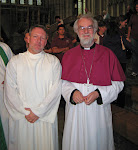
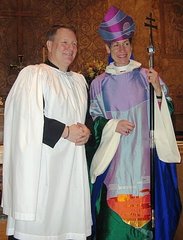
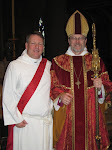
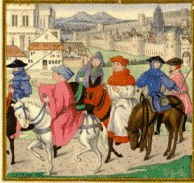
In the historic church of St. James in Compostela, Spain -the terminal shrine of one of the most important medieval pilgrimage routes - they like a little incense with their worship!
Showing posts with label Ecclesiastical Polity. Show all posts
Showing posts with label Ecclesiastical Polity. Show all posts
14 April 2008
The Botafumerio at Sant'iago de Compostela
23 March 2008
An Easter Celebration
 I was kitted out for my first ordained Easter in all the finery that St. James Fordham Manor could muster -- and they could muster quite a bit as it turned out! The cloth of gold dalmatic is a donation from a monk of vicar's order, the maniple and Byzantine stole is from the vicar's ordination set. More finery than I will likely ever have the honor to don again.
 Here is Mr. George Greene, Master of Ceremonies and Sub-deacon for the day (and a great teacher to me of my liturgical duties), the Rev. Tobias S. Haller, BSG, vicar of St. James, and the new deacon.
 The vicar and myself at the Easter luncheon which was also an ordination celebration.
 Ms. Patience Okuwoha, longtime member of St. James and one of my ordination sponsors.
 The fine ladies of St. James who prepared and served today's celebratory lunch.
 The parish hall was well and truly packed.
 The delicious cake!
A very big thank you to all the wonderfully supportive people of St. James Fordham Manor. They were most generous in celebrating the resurrection of our Lord and my ordination. A day I will long remember.
19 March 2008
My brother and sisters....
It's taken a few days, but here are a few shots from my ordination to the diaconate on Saturday, March 15th, 2008 in the Cathedral Church of St. John the Divine, in the Episcopal Diocese of New York, the Rt. Rev. Mark S. Sisk, Bishop...
 This is all of us. In order from the right: me, Kathryn Reinhard, Stephanie Allen, Arianne Weeks, Lindsay Lunnum, Candace Sandfort, Yejide Peters. In the midst of us is Bishop Sisk, flanked by the cathedral deacons. And peeking around Candace's head is Canon Coles. This year's EDNY class of transitional deacons consisted of myself and six women, hence the bishop's form of address to us during our vows: "My brother and sisters..." At rehearsal on Friday, Lindsay turned to me after the first time we heard that particular locution and said, "Well, I guess that's you." Yep, I guess so.
Just before the big event, this is Patience Okwuoha from St. James Fordham Manor, Sibyl Piccone, from Ascension, myself and Tobias S. Haller, BSG, Vicar of St. James. These good folks stood as my presenters for the ordination.
 My great seminary and EDNY friend Arianne Weeks and her daughter (and future deacon) Dorothea.
 The man without whom none of this would be possible, the Right Reverend Mark Sean Sisk, Bishop of the Episcopal Diocese of New York.
  The woman without whom none of this would be possible, The Very Reverend Constance C. Coles, Canon for Ministry for the Episocopal Diocese of New York.
  Actually, when it comes down to it, this is the man without whom none of this would be possible, the "bishop of my heart" Denton L. Stargel. (NB: if the camera adds 10 pounds, the while garment I'm wearing, called an alb, adds 40 pounds at least!)
  My mentor and friend, the Rev. Tobias S. Haller, BSG, vicar of St. James Fordham Manor, my field ed site for these past two years. And two representatives of the many St. James parishioners that supported me at my ordination, Ms. Monica Stewart, and Ms. Pearline Bashford, in hats, of course!
  Ken Luymes and Ann Marie Duross of International Rescue Committee days.
 The amazing Miss Eliza Williams of International Rescue Committee (ret).
 Steve Dahut and Karen Azeez. Karen plays a part in this story. When we were both working at City Harvest, and discussing graduate school as a someday kind of thing, Karen said, "You should study theology in grad school!" As you can see, that seed has taken root.
 Just two of the many Ascensionites who showed up to lend their support, Jenny Landis and Fr. Mark Hummel.
It was an awesome and inspiring day all around. Thanks and praise go to very many people for helping me get to this day: Denton in particular, my many seminary classmates and friends, Subdean Titus Presler, my advisor at GTS, my mentors Fr. Haller and Fr. Andrew, all the good people of Church of the Ascension, Manhattan and St. James Fordham Manor, the Bronx, especially Patience and Sibyl, the good folks of the Episocopal Diocese of New York, especially Canon Coles, Bishop Sisk, and the unfailing Alito Orsini -- and, of course, to God from whom all blessings flow...
Glory to God whose power, working in us, can do infinitely more than we can ask or imagine: Glory to God from generation to generation in the Church, and in Christ Jesus for ever and ever. Amen. (Ephesians 3:20, 21).
02 March 2008
24 February 2008
One, Holy, Catholic and Apostolic
Yes, Catholic! And One, and Holy, and Apostolic... These terms are called the 'Four Marks of the Church' and there's a pretty good explanation of their meaning and use on Wikipedia.
Almost all Christians use the Apostles Creed, and most use the Nicene Creed,  and in each of these the term 'catholic' is used to describe the church. In these contexts, catholic is taken to mean 'universal', as it does in the original Greek. By universal, we mean that God's grace through Jesus Christ is available to everyone, everywhere at all times and in all places.
 and in each of these the term 'catholic' is used to describe the church. In these contexts, catholic is taken to mean 'universal', as it does in the original Greek. By universal, we mean that God's grace through Jesus Christ is available to everyone, everywhere at all times and in all places.
As Bill Cain, SJ pointed out once at a meeting at the Church of Saint Francis Xavier, there's a innate contradiction in the idea of a "Roman Catholic" church. Can you be universal and yet require obedience to the Bishop of Rome? Most Anglicans, Lutherans, Eastern Orthodox and Protestants would answer 'no'. As Ed Condry, canon treasurer of Canterbury Cathedral, pointed out during a recent session of the Canterbury Scholars, Anglicans have always considered our branch of the universal church a temporary approximation of the unity that we will find in the ultimate kingdom of God that awaits us at the end of time. We don't claim exclusive rights to the salvation of Christ Jesus. Rather, we claim that that salvation is Christ's gift to all humanity.
And in the Episcopal Church, we practice our catholicity every Sunday. In the Episcopal Church all baptized Christians are invited to partake of the Eucharist. Our baptism makes us Christians, and Christianity, as we understand it, is catholic by definition. And every Christian of every stripe is welcome at God's table.
Two Ordinations?!?!?!?!?
Here's the text of a note that I included with my (few) mailed invitations that explains (somewhat) why I'll be ordained twice -- and that your prayers and presence at either are both will be a great joy to me:
Dear friends and family,
This message comes to you with what are for me some very glad tidings! I am to be ordained a deacon in the Episcopal Church on March 15th, as the enclosed invitation details. You may not be familiar with the traditions surrounding ordination in the Episcopal Church. So, here is a little summary:
The Episcopal Church follows the centuries old tradition of “successive orders,” which means that one is first ordained a deacon before being ordained a priest; and one is a deacon, and then a priest before becoming a bishop. This is done not only to continue a biblical and historical precedent, but also to remind those who are ordained and all in the church that ministry begins in service, and service has always been the primary role of a deacon.
What does this mean for you? It means that there’s going to be a great celebration in a few weeks at the Cathedral Church of St. John the Divine in New York and I’d love for you to be there. But it also means that “God willing, and the people consenting,” there will be another celebration on Saturday, September 20, 2008 when I am ordained a priest. I would be thrilled to have all of you present for both ordinations. But, please know that your prayers for both -- and presence at which ever celebration is convenient for you -- will be most welcome and greatly appreciated.Joyfully,

20 January 2008
Roadside Ecclesiology
It was an interesting road trip from Memphis, TN to New York, NY. 1058 miles give or take, and lots of roadside theology along the way. 
I'm not sure how much of a Greek scholar is the pastor of the Shiloh (TN) Church of Christ -- regardless his instincts are right on. In the New Testament, the Greek word we translate as 'church' is 'ekklesia' and means literally 'assembly'. The pastor's message here is a bit more eccleisologically minded than one generally finds in Southern Protestantism. It asserts that the church is a gift from God, which is in keeping with more high church, catholic ecclesiology. The 'assemly necessary' quip is well taken. St. Paul's vision of the church was of an assembled body of believers, individual members of the body of Christ on earth coming togetheer -- the 'church militant' as it is called. It matters that each of us as members of the body of Christ do assembly. Some assembly is required. It is important to go to church on Sunday -- not perhaps for what you get out of it, but rather what you are required to give to it.
 And now we turn to the Church Triumphant, or at least one vision of it. This is the back of a tombstone in a cemetery just off I-81 somewhere north of Roanoke, VA. We stopped to let the dog have a walkabout and to use the outhouse in the cemetery ourselves (yes, there was one) and saw this. It's a nice sentiment, I suppose. I like the almost Mormon idea of a union here on earth lasting into the next life. But I'm not sure I want to think of continuing the labor God calls us to here on earth in the great hereafter. I'd like to think of us praising God for eternity, not trucking forever! But hey, if you really like trucking, then I guess that's what paradise is all about!
08 December 2007
God's Place in Politics
The New York Times has some sensible things to say about Mitt Romney's speech on his faith and its role in his political ambitions. Here are some quotes -- the full text of the editorial is at the bottom of this post.
Mr. Romney filled his speech with the first myth — that the nation’s founders, rather thanseeking to protect all faiths, sought to imbue the United States with Christian orthodoxy... Mr. Romney dragged out the old chestnuts about “In God We Trust” on the nation’s currency, and the inclusion of “under God” in the Pledge of Allegiance — conveniently omitting that those weren’t the founders’ handiwork, but were adopted in the 1950s at the height of McCarthyism.
In his book, “American Gospel,” Jon Meacham quotes James Madison as saying that law was “meant to comprehend, with the mantle of its protection, the Jew and the Gentile, the Christian and the Mahometan, the Hindoo and infidel of every denomination.”
The founders were indeed religious men, as Mr. Romney said. But they understood the difference between celebrating religious faith as a virtue, and imposing a particular doctrine, or even religion in general, on everyone. As Mr. Meacham put it, they knew that “many if not most believed, yet none must.”
We believe democracy cannot exist without separation of church and state, not that public displays of faith are anathema. We believe, as did the founding fathers, that no specific religion should be elevated above all others by the government... That is why they wrote in Article VI that “no religious test shall ever be required as a qualification to any office or public trust under the United States.”


The full text of the NY Times editorial is here.
29 November 2007
Words of Wisdom and Faith from the Bishop of New York
 Every year at the Episcopal Diocese of New York's convention, our bishop, the Rt. Rev. Mark S. Sisk, gives an address. Every year, I find it to be compelling, thoughtful, provocative and important to our continued mission of Christian witness and action. Here are a few excerpts. A link to the full text of the address is below.
The witness to God’s radical love has become ever more difficult. The difficulty arises from two deeply linked sources. The first, and more superficial cause, is a shift in cultural values that has tended to muffle all but the most extreme voices…
The full text of the bishop's address can be found here.
Of late I have been meeting with other religious leaders of a like mind in hopes that together, we can find a way to raise the voice of moderation in the midst of the cacophony that surrounds us.
However, the deeper truth is that deafness to all but the most extreme voices is itself a perfectly natural development in a society, in a world, in which the forces of extremism have moved from the margins to the very center of our common life.
Who among us, in his or her wildest imagination, would ever have guessed that candidates for the Presidency of this great nation, or a nominee for its highest law enforcement officer, would find themselves seriously debating fine nuances of what is an acceptable method for torture and what is not. To what have we come? And how have we gotten here?
These are not easy times in which to serve. But by God’s grace they are the times we have been given. Let us so immerse ourselves in the life of the living Lord that we may find a new and life giving word of hope and justice, to the community of which we are a part.
Let it never be said of us, that we, in our generation cowered before the work that was ours to do. By the power of God’s Spirit who lives within us, let us find in one another the strength of the One who sustains us all. Let us have the courage to live without fear because the God who loves us and sustains us is more powerful than all the evil forces that drive us apart.
Rejoice in each other. Rejoice in the work that God has given us do, Rejoice in the Life of the Living One who loves us, now and unto the ages of ages.
18 November 2007
Sex in the Bible!??!? Well....
My New Testament professor Deirdre Good has some astute observations on sex, sexuality and gender in the Bible. Here's a quote:
If sexuality is marginal in biblical tradition and the Bible has no vision to help integrate human sexuality, and if a Christian theology of the sacrament of marriage is patristic and medieval, what might be the consequences for our contemporary debates about sexuality in the church and elsewhere? One is that since sexuality seems to be of no great concern to either God or Jesus according to the biblical record, we need to recognize this gap before we rush to fill it.

The rest of Deirdre's scholarly good sense can be found here. Hat tip to Episcopal Cafe for the link.
26 October 2007
How NOT to welcome the newcomer...
Very funny clip from a BBC comedy show... Is this what John Drymon would be like with a mustache and a British accent???
Mirage in the desert: the myth of the 'Global South'
Here's an analysis of just what the so called 'Global South' is and is not from the Rev. Frederick Quinn. Some short quotes:
"Global South" implies a monolithic body when in reality the group's membership appears to be porous, driven by a small number of special interest advocates primarily in Nigeria, Uganda, Kenya, Rwanda, and their American franchise holders."
"The vision of Christianity that Akinola and his supporters present does not represent the breadth and depth of religion in Africa. Scripturally and structurally, it mirrors the remnants of a colonial church tradition, one where African bishops rigidly follow in the footsteps of a departed generation of autocratic British mentors." 
Thanks to Episcopal Life Online for the link to Dr. Quinn's piece.
12 October 2007
The African war over homosexuality
Here's an interesting perspective on the history of the conflict between Christianity and homosexuality in Africa; excerpted from The New Republic by Episcope.
Unholy Communion
by Philip Jenkins
The New Republic
10.11.07 Issue date 10.08.07
In the past few years, conservative Episcopalians from a number of U.S. congregations have voted to bolt from their church and place themselves under various African leaders, including Nigeria's Anglican primate Peter Jasper Akinola. The source of the conservatives' discontent with the U.S. Episcopal Church was its liberal position on homosexuality. It had, after all, named an openly gay man bishop of New Hampshire. That was also the reason Akinola and other African clergy appealed to these largely white congregations. Akinola's church views any gay manifestation as an "acquired aberration" and has compared the U.S. Episcopal Church to a "cancerous lump." He has also backed legislation that prescribes severe prison sentences for gay sex....
Many African societies have well-established traditions of same-sex interactions and gay subcultures. In different parts of the continent, we can find everything from warrior cultures in which mature men sexually initiate youths, to examples of gender crossing. A decade ago, the varieties of African homosexuality were documented in the book Boy-Wives and Female-Husbands, edited by Will Roscoe and Stephen O. Murray.
Why, then, did opposition to gay rights become so critical for many African Christians? The answer has a lot to do with the rapid spread of Christianity on the continent in a relatively short time. In 1900, Africa had 10 million Christians, representing around 10 percent of the population. By 2000, that figure had grown to 360 million, or 46 percent. As a result, most African Christians today are first- or second- generation members of the faith, and many are adult converts. Sociologists generally agree that newer religious groups tend to have more literal approaches to scripture. In practice, of course, literalism still leaves plenty of room for debate and interpretation; but, when the Bible specifically condemns a particular sin--and same-sex interaction is repeatedly denounced in both the Old and New Testaments--that makes it difficult for literalists to find wiggle room.
In other ways, too, the rapid expansion of Christianity has conditioned African views on homosexuality. African churches exist in a ferociously competitive environment, one where traditional groups--like Anglicans and Catholics--must fight to maintain their market share against newer Pentecostal denominations, with their enticing promises of miracles and healings. The last thing the older churches need is a suggestion that their commitment to scriptural truth is anything less than absolute or that they are any less rigorous than their rivals in condemning sin.
The other key rival--and another factor shaping moral attitudes--is Islam. Over the past century, African Christianity has grown much more rapidly than Islam, a fact that puzzles and infuriates Muslims who regard the continent as naturally theirs. In 1900, for instance, Christians accounted for just 1 percent of the people of what would become the state of Nigeria; Muslims made up 26 percent. By 1970, however, the religions had achieved parity, each having around 45 percent of the population. And some recent polls suggest that, today, the nation has a Christian plurality. Against this background of rivalry and potential violence, Christians cannot be seen to concede anything to Muslims in terms of their commitment to strict morality. Even the harsh anti-gay measures that Akinola backs in Nigeria are still milder than the provisions enforced under the sha- ria code that prevails in one-third of the country's states, which includes the death penalty for homosexuality. Moreover, by condemning sexual liberalism, African churches are making clear to their own members and their Muslim neighbors that they are not puppets of the West. Moral conservatism thus serves to assert cultural independence--a link that requires sexual immorality to be portrayed as a Euro-American import. The Muslim context helps explain the sensitivity of gay issues in one other key respect. In the region later known as Uganda, Christianity first arrived in the 1870s, when the area was already under Muslim influence and a hunting ground for Arab slave-raiders. The king of Buganda had adopted Arab customs of pederasty, and he expected the young men of his court to submit to his demands. But a growing number of Christian courtiers and pages refused to participate, despite his threats, and an enraged king launched a persecution that resulted in hundreds of martyrdoms: On a single day, some 30 Bugandans were burned alive. Yet the area's churches flourished, and, eventually, the British expelled the Arab slavers. That foundation story remains well-known in the region, and it intertwines Christianity with resistance to tyranny and Muslim imperialism--both symbolized by sexual deviance. Reinforcing such memories are more recent experiences with Muslim tyrants, such as Idi Amin, whose victims included the head of his country's Anglican Church. For many Africans, then, sexual unorthodoxy has implications that are at once un-Christian, anti-national, and oppressive.
…
To be sure, Africa is a diverse continent, and some voices are more liberal on gay issues than others. Many of the most progressive can be found in South Africa, arguably one of the most gay-friendly countries in the world. Its constitution outlaws discrimination on grounds of sexual orientation, and, in 2006, the country legalized same-sex marriage. Many churches certainly opposed this latter measure, but the depth of feeling is nothing like what we find in a country like Nigeria. Anglican leader Desmond Tutu has spoken out for gay rights, declaring, "To penalize somebody for their sexual orientation is the same as what used to happen to black South Africans for something about which we could do nothing." Generally, bishops who do criticize homosexual behavior rank it low on their hierarchy of sins. The country's current Anglican primate, Njongonkulu Ndungane, calls homosexuality a "pastoral, secondary problem," and has rebuked Akinola for failing to address more pressing issues in his backyard.
One explanation for this phenomenon is that South Africa's unique history has given its leaders more room to promote tolerance on gay rights. After all, given the African National Congress's recent credentials in resisting white domination, the government can hardly be accused of passively succumbing to Western influence.
09 October 2007
Open letter to the LGBT Community from Bishop Gene Robinson
 Bishop Gene Robinson has written to gays and lesbians about the recent House of Bishops meeting in New Orleans. He gives his sense of the meeting and why he voted for the statement issued by the bishops.
October 9, 2007
"Now that the Church has had some time to absorb and consider the recent meeting of the House of Bishops in New Orleans and its response to the Anglican Communion, I’d like to share with you what I experienced at the recent House of Bishops meeting, and where I think we are as a result.
There is NO “mind of the House” nor a “mind of the Episcopal Church.” In fact, we are a House and a Church of many different minds. We are in transition from the Church we have been called to be in the past, to the Church we are called to be now and in the future. We are not there yet.
I value highly the thoughts and needs of my brother and sister conservative bishops, who have no intention of leading their flocks out of the Episcopal Church, but come out of dioceses which, for the most part, find the Episcopal Church’s actions of the last four years troublesome and alarming. I listened to them when they voiced the fears of their people that changing our views on homosexuality is a precursor to moving on to denying important tenets of our orthodox faith, from the Trinity to the Resurrection. We worked for a statement which would reflect the diversity we recognize and value as a strength of our Episcopal communion. It was our goal to describe the Church as it currently is: NOT of one mind, but struggling to be of one heart.
My own goal – and that of many bishops – was to do NOTHING at this meeting. That is, our goal, in response to the Primates, was simply to state where we are as an Episcopal Church, not to move us forward or backward. Sometimes, “progress” is to be found in holding the ground we’ve already achieved, when “moving forward” is either untimely or not politically possible. And, doing nothing substantive respects the rightful reminder to us from many in the Senior House that the House of Bishops cannot speak for the whole Church, but rather must wait until all orders of ministry are gathered for its joint deliberations at General Convention.
While many of us worked hard to block B033 and voted against it at General Convention, it IS the most recent declaration of all orders of ministry gathered as a Church. The Bishops merely restated what is, as of the last General Convention.Yes, we did identify gay and lesbian people as among the group included in those who ‘present a challenge” to the Communion. That comes as a surprise to no one. It is a statement of who we are at the moment. Sad, but true.
Many bishops spoke on behalf of their lgbt members and worked hard to prevent our movement backwards. We fought hard over certain words, certain language. We sidelined some things that truly would have represented a movement backwards.
I want to tell you what I said to the Archbishop of Canterbury. In the course of his comments, it  seemed to me that the Archbishop was drawing a line between fidelity to our gay and lesbian members, and fidelity to the “process of common discernment,” which he had offered as a prime function of a bishop. I heard him saying that gay and lesbian members of our Church would simply have to wait until there was a consensus in the Communion. When we were invited to respond, I said something like, “Your Grace, I have always respected you as a person and your office, and I always will. But I want you to know and hear, that to me, a gay man and faithful member of this Church, this is one of the most dehumanizing things I’ve heard in a long time, and I will not be party to it. It reminds me of Jesus question ‘Is the Sabbath made for man, or man for the Sabbath?’ Choosing a process over the lives of human beings and faithful members of this Church is simply unacceptable and unscriptural.” The next morning, the Archbishop tried to assure us that he meant both/and rather than either/or. I tried to speak my truth to him.
On the issue of same sex unions, I argued that our statement be reflective of what is true right now in the Episcopal Church: that while same sex blessings are not officially permitted in most dioceses, they are going on and will continue to go on as an appropriate pastoral response to our gay and lesbian members and their relationships. Earlier versions of our response contained both sides of this truth. I argued to keep both sides of that truth in the final version, providing the clarity asked for by the Primates.
Others made the argument that to state that “a majority of Bishops do not sanction such blessings” implied that a minority do in fact sanction such blessings, and many more take no actions to prevent them. All this without coming right out and saying so. That argument won the day. I think it was a mistake.
Another issue to which I spoke was this notion of “public” versus “private” rites. I pointed out on the floor that our very theology of marriage is based on the communal nature of such a rite. Presumably, the couple has already made commitments to one another privately, or else they would not be seeking Holy Matrimony. What happens in a wedding is that the COMMUNITY is drawn into the relationship – the vows are taken in the presence of that community and the community pledges itself to support the couple in the keeping of their vows. It is, by its very nature, a “public” event – no matter how many or how few people are in attendance. The same goes for our solemn commitments to one another as lgbt couples.
I suspect that these efforts to keep such rites “private” is just another version of “don’t ask, don’t tell.” If avoidance of further conflict is the goal, then I can understand it. But if speaking the truth in love is the standard by which we engage in our relationships with the Communion, then no.
Let me also state strongly that I believe that the Joint Standing Committee of the ACC and Primates MISunderstood us when they stated that they understood that the HOB in fact “declared a ‘moratorium on all such public Rites.’” Neither in our discussions nor in our statement did we agree to or declare such a moratorium on permitting such rites to take place. That may be true in many or most dioceses, but that is certainly not the case in my own diocese and many others. The General Convention has stated that such rites are indeed to be considered within the bounds of the pastoral ministry of this Church to its gay and lesbian members, and that remains the policy of The Episcopal Church.
Lastly, let me respond to the very real pain in the knowledge that the change we long for takes time. This movement forward is going to take a long time. That doesn’t make it right. It certainly does not make it easy. Dr. King rightly said that “justice delayed is justice denied,” but that didn’t stop him from accepting and applauding incremental advances along the way.
We have every right to be impatient. We MUST keep pushing the Church to do the right thing. We must never let anyone believe that we will be satisfied with anything less than the full affirmation of us and our relationships as children of God.
BUT, I will continue to try to remain realistic in my approach. I work hard, and pray hard, to find the patience to stay at the table as long as it takes. And I hope we can refrain from attacking our ALLIES for not doing enough, soon enough. The bridges we are burning today may turn out to be the bridges we want to cross in the future. Let’s not destroy them.
We need to be in this for the long haul. For us to get overly discouraged when we don’t get all that we want, as fast as we want, seems counterproductive to me. We should never capitulate to less than all God wants for us, but to lose heart when we don’t move fast enough, and to attack the Church we are trying to help redeem, seems counterproductive.
The two days of listening to the Archbishop of Canterbury and some members of the ACC were the two hardest days I’ve had since my consecration. (It was a constant and holy reminder to me of the pain all of YOU continue to experience every day at the hands of a Church which is not yet what it is called to be. Ours is a difficult and transforming task: to continue serving a church that seems to love us less than we love it!) I was comforted by the support I DID receive from those straight bishops who spoke up for us, and especially by many of the Bishops of color, who implicitly “got” what I was trying to say and defied the majority with their support of me and of us. I was even encouraged by many conservative bishops’ willingness to work together to craft a statement we, liberal and conservative alike, could all live with.
I believe with my whole heart that the Spirit is alive and well and living in our Church – even in the House of Bishops. I believe Jesus when he told his disciples, on the night before he died for us, that they were not ready to hear and understand all that he had to teach them – and that he would send the Holy Spirit to lead them into all truth. I believe that now is such a moment, when the Church, in its plodding and all-too-slow a way, is being guided into truth about its gay and lesbian members. It took ME 39 years to acknowledge who I was as a gay man and to affirm that I too am considered precious by God. Of course, the very next day after telling my parents, I expected them immediately to catch up to what had taken me 39 years to come to. Mercifully, it has not taken them the same 39 years to do so. The Church family is no different. It is going to take TIME.
I voted “yes” to the HOB statement. I believe it was the best we could do at this time. I am far less committed to being ideologically and unrelentingly pure, and far more interested in the “art of the possible.” Am I totally pleased with our statement? Of course not. Do I wish we could have done more? Absolutely. Can I live with it? Yes, I can. For right now. Until General Convention, which is the appropriate time for us to take up these issues again as a Church, with all orders of ministry present. I am taking to heart the old 60’s slogan, “Don’t whine, organize!”
I am always caught between the vision I believe God has for God’s Church, and the call to stay at the table, in communion with those who disagree with me about that vision – or, as is the case for most bishops, who disagree about the appropriate “timing” for reaching that vision of full inclusion. In this painful meantime, please pray for me as I seek to serve the people of my diocese and you, the community of which I am so honored to be a part."
Your brother in Christ,
+Gene
Thanks to Episcopal Cafe for text of +Robinson's letter.
06 October 2007
Got Covenant?
The Rev. Canon Dr. Jane Shaw, dean of divinity, chaplain and fellow of New College, Oxford, chimes in in The Guardian about her favorite covenant:
Face to Faith:
The bond of baptism means we have no need for a new 'essential' Anglican covenant, says Jane Shaw
The Rev Canon Dr Jane Shaw
Saturday October 6, 2007

For Christians, the rite of baptism brings us into the body of Christ. It is about sharing a radical equality as children of God. Paul made this clear in his letter to the Galatians: "For in Christ Jesus you are all children of God through faith ... There is no longer Jew or Greek, there is no longer slave or free, there is no longer male or female." This was startling in the hierarchical Roman society into which the church was born, where you might find yourself in a small room, knee to knee, sharing a meal with a man who was your social superior, or with a slave or a Roman matron, with whom you would never, in the normal conventions of the day, have mixed. It is startling today; not in the same way, not in the formal breaking of hierarchies in our apparently democratic society, but in the linking of different peoples across villages, towns, countries and the globe, through that bond of baptism. We call this a baptismal covenant.
The gospels relate that when John the Baptist baptised Jesus, God's voice boomed from the heavens: "This is my son, the Beloved, with whom I am well pleased." And the heavens echo with that phrase every time a child or adult enters the waters of baptism: "This is my daughter, my son, the Beloved, with whom I am well pleased." Baptism is both a recognition and an acceptance on our parts that we are always and already loved by God. Baptism marks a choice to enter into a community that first of all believes that all human beings are made in the image and likeness of God and are therefore God's beloved; and, secondly, accepts the call to express that love in the world. Christians follow Jesus, who said to his disciples: love one another as I have loved you. Baptism is a call to serve based on acknowledging the worth of every single human being. We are each, lay and ordained, called to that radical service grounded in love. In the baptismal covenant, there are rightly no distinctions between persons. We are all the beloved children of God, called to share life with each other and love one another as God loves us.
There is much talk at present in the Anglican communion of a new covenant to bind us together. This is seen as a solution to our problems, to our disagreements about homosexuality. Some argue that we just need to agree to certain new "essentials". But many of us hesitate to embrace such a covenant because we already have a covenant: our baptismal covenant. That is how we are joined together and it is based on the long-established "essentials": the historic creeds. From the very earliest days of Christianity, baptism marked that moment when men and women assented to the Christian essentials - one God: Father, Son and Holy Spirit - and came into relationship with those who shared this belief in the creator God, the risen Christ and the Spirit who sustains us daily. Baptism is therefore the foundation of our identity as Christians. With Paul's words to the Galatians in our memories, we hesitate to assent to a covenant in which there will be a new distinction between lay and ordained by handing over decision-making power to the Anglican primates. Having made our assent to the historic creeds, we hesitate to create new "essentials" about an issue - homosexuality - that may be purely of this moment. (emphasis added)
Let me suggest another response to the Anglican crisis. All we really have to do in the midst of this crazy church dispute is be awake to our relationship with a loving God. And to do that, warring Anglicans simply have to recall their baptism: that moment when the waters washed over us and the heavens echoed with God's declaration about each of us - you are my beloved son, my beloved daughter, with you I am well pleased. If we remember that, really remember it, disputes might "wither like the grass and fade like the flowers" as Isaiah puts it, as we are bathed in the knowledge of God's love for each and every one of us.
Thanks to Thinking Anglicans for the link.
Face to Faith:
The bond of baptism means we have no need for a new 'essential' Anglican covenant, says Jane Shaw
The Rev Canon Dr Jane Shaw
Saturday October 6, 2007
For Christians, the rite of baptism brings us into the body of Christ. It is about sharing a radical equality as children of God. Paul made this clear in his letter to the Galatians: "For in Christ Jesus you are all children of God through faith ... There is no longer Jew or Greek, there is no longer slave or free, there is no longer male or female." This was startling in the hierarchical Roman society into which the church was born, where you might find yourself in a small room, knee to knee, sharing a meal with a man who was your social superior, or with a slave or a Roman matron, with whom you would never, in the normal conventions of the day, have mixed. It is startling today; not in the same way, not in the formal breaking of hierarchies in our apparently democratic society, but in the linking of different peoples across villages, towns, countries and the globe, through that bond of baptism. We call this a baptismal covenant.
The gospels relate that when John the Baptist baptised Jesus, God's voice boomed from the heavens: "This is my son, the Beloved, with whom I am well pleased." And the heavens echo with that phrase every time a child or adult enters the waters of baptism: "This is my daughter, my son, the Beloved, with whom I am well pleased." Baptism is both a recognition and an acceptance on our parts that we are always and already loved by God. Baptism marks a choice to enter into a community that first of all believes that all human beings are made in the image and likeness of God and are therefore God's beloved; and, secondly, accepts the call to express that love in the world. Christians follow Jesus, who said to his disciples: love one another as I have loved you. Baptism is a call to serve based on acknowledging the worth of every single human being. We are each, lay and ordained, called to that radical service grounded in love. In the baptismal covenant, there are rightly no distinctions between persons. We are all the beloved children of God, called to share life with each other and love one another as God loves us.
There is much talk at present in the Anglican communion of a new covenant to bind us together. This is seen as a solution to our problems, to our disagreements about homosexuality. Some argue that we just need to agree to certain new "essentials". But many of us hesitate to embrace such a covenant because we already have a covenant: our baptismal covenant. That is how we are joined together and it is based on the long-established "essentials": the historic creeds. From the very earliest days of Christianity, baptism marked that moment when men and women assented to the Christian essentials - one God: Father, Son and Holy Spirit - and came into relationship with those who shared this belief in the creator God, the risen Christ and the Spirit who sustains us daily. Baptism is therefore the foundation of our identity as Christians. With Paul's words to the Galatians in our memories, we hesitate to assent to a covenant in which there will be a new distinction between lay and ordained by handing over decision-making power to the Anglican primates. Having made our assent to the historic creeds, we hesitate to create new "essentials" about an issue - homosexuality - that may be purely of this moment. (emphasis added)
Let me suggest another response to the Anglican crisis. All we really have to do in the midst of this crazy church dispute is be awake to our relationship with a loving God. And to do that, warring Anglicans simply have to recall their baptism: that moment when the waters washed over us and the heavens echoed with God's declaration about each of us - you are my beloved son, my beloved daughter, with you I am well pleased. If we remember that, really remember it, disputes might "wither like the grass and fade like the flowers" as Isaiah puts it, as we are bathed in the knowledge of God's love for each and every one of us.
Thanks to Thinking Anglicans for the link.
25 July 2007
Anglican Insights

Don't think I'll go into great detail about the course work I'm doing here. But here are a few insights that might be of interest:
- I think of myself and my church as operating from a position of great privilege. I am a rich, white, well-fed American Anglican, after all. But in hearing the stories of my fellow Anglicans, I find that my story is not so different. We have all struggled with faith issues. We have all struggled with our call to the priesthood. The exterior circumstances are greatly different. We have different levels of access to resources. But our interior lives are very surprisingly similar.
- In an attempt to define Anglicanism, a priest from Papua New Guinea said, "There are no locked doors in Anglicanism."
- A priest from Zambia said, "An Anglican is someone who celebrates life while on the way to heaven."
- A priest from Nigeria asked, "Is my faith born out of conviction or condition?" His answer went something like, "If it is conditional, changes will cause me to loose my faith. If it is born of conviction, I can leave my culture and language be swallowed up to serve others."
- A priest from India noted, "Comfort is a hindrance to hearing God. Like Buddha, Moses had to leave the Pharaoh's palace to hear God calling him."
- From Evelyn Underhill: "The two things the laity want from the priesthood are spiritual realism and genuine love of souls."
- Canterbury and Kent share a root which means 'boundary'. Kent is on the edge of England and the sea, and Canterbury exists at the edges where the churches of the Anglican Communion meet as one.
- Me: "Ruth defied Naomi's admonition to walk apart from her and to return home. Ruth had become Naomi's family and she would not relinquish those family bonds. She stayed with Naomi though Naomi asked her not to."
- A priest from Burundi: "Ruth submitted herself to Naomi, and put away her own land and language and took on Naomi's. She put aside her own self for the sake of the larger whole."
- Find time to be idle with scripture and tradition
- Remember the importance of the ordinary
- Live near the edge, on the border -- not always at the center.
- Excellent bibles studies each morning that never fail to open my eyes to a way of seeing scripture.
- A great introduction to Anglicanism as it is lived at Canterbury by Canon Ed Condry.
- Some great sessions from Prof. Barney Hawkins on Christian Leadership -- really informative and important.
- Sessions from the Rt. Rev. Josiah Fearon, Archbishop of Kaduna in the Church of Nigeria on Islam -- along with some revelations from the sometimes restive borderline where Christianity and Islam meet.
- A session on a "mission-shaped" church from the Rt. Rev. Graham Cray, Bishop of Maidstone of the Church of England. (I found myself in disagreement with Bp. Cray on a few points. It was nonetheless informative to see that some evangelicals really do speak with British accents.)
- A Candlelight Pilgrimage through the cathedral at night that ended in a circle gathered on the spot where St. Thomas Beckett's Shrine once stood. We all offered prayers in our own languages, which was amazing. One after another prayers were repeated in all the languages of our group. Mine went something like:
Mother-Father God, we offer our thanks for our ancestors in faith, the generations upon generations of faithful hearts who have passed the story of salvation on to us. With all of us from every corner of the world gathered here, we pray for peace in Iraq, in Afghanistan, in every corner of the earth -- and in every human heart. These things we pray in the name of the One God who is our creator, our redeemer and our
sustainer. Amen.

15 July 2007
War, and rumors of war...
 My brother (at left) leaves tomorrow morning at 0300 for an undisclosed location in Afghanistan. He'll be there for up to 18 months fighting a newly invigorated Taliban and Al Qaeda.
President Bush claims that, “The same folks that are bombing innocent people in Iraq were the ones who attacked us in America on September the 11th, and that’s why what happens in Iraq matters to the security here at home.” Many critics disagree with the president's assertion.
As many of you know, I am a survivor of the attack on the World Trade Center on September 11, 2001. Now my brother is being sent to try to defeat those who perpetrated that attack, nearly 6 years later.
IMHO, this war in Afghanistan should be over my now, and my brother should be home with his family -- and the war in Iraq should never have happened.
As the New York Times put it on July 13, 2007 -- three days before my brother deployed to Afghanistan --
Al Qaeda in Mesopotamia did not exist before the Sept. 11 attacks. The Sunni group thrived as a magnet for recruiting and a force for violence largely because of the American invasion of Iraq in 2003, which brought an American occupying force of more than 100,000 troops to the heart of the Middle East, and led to a Shiite-dominated government in Baghdad.
Read the Times' appraisal of Bush's assertions in an article entitled "Bush Distorts Qaeda Links, Critics Assert" here, and more about the cost of the Iraq war in terms of the focus on Afghanistan here.
09 July 2007
The Road Home
The gig is up at the New York Times. After months and months of measured, moderate opinion on ending the war in Iraq, Sunday's editorial page calls for a complete withdrawal. Quite an evolution for the 'newspaper of record'. Here are some excepts from the Times editorial (emphasis added):
"It is time for the United States to leave Iraq, without any more delay than the Pentagon needs to organize an orderly exit...
At first, we believed that after destroying Iraq’s government, army, police and economic structures, the United States was obliged to try to accomplish some of the goals Mr. Bush claimed to be pursuing, chiefly building a stable, unified Iraq. When it became clear that the president had neither the vision nor the means to do that, we argued against setting a withdrawal date while there was still some chance to mitigate the chaos that would most likely follow...
Continuing to sacrifice the lives and limbs of American soldiers is wrong. The war is sapping the strength of the nation’s alliances and its military forces. It is a dangerous diversion from the life-and-death struggle against terrorists. It is an increasing burden on American taxpayers, and it is a betrayal of a world that needs the wise application of American power and principles...
Despite President Bush’s repeated claims, Al Qaeda had no significant foothold in Iraq before the invasion, which gave it new base camps, new recruits and new prestige...
This war diverted Pentagon resources from Afghanistan, where the military had a real chance to hunt down Al Qaeda’s leaders. It alienated essential allies in the war against terrorism. It drained the strength and readiness of American troops. And it created a new front where the United States will have to continue to battle terrorist forces and enlist local allies who reject the idea of an Iraq hijacked by international terrorists. The military will need resources and bases to stanch this self- inflicted wound for the foreseeable future...
President Bush and Vice President Dick Cheney have used demagoguery and fear to quell Americans’ demands for an end to this war. They say withdrawing will create bloodshed and chaos and encourage terrorists. Actually, all of that has already happened — the result of this unnecessary invasion and the incompetent management of this war...
This country faces a choice. We can go on allowing Mr. Bush to drag out this war without end or purpose. Or we can insist that American troops are withdrawn as quickly and safely as we can manage — with as much effort as possible to stop the chaos from spreading."
My $.02: By any definition, our intervention in Iraq is now a tragedy, and one that will continue for some time. How sad, really. The war against terror was never in Iraq, until we put it there. And we've seriously delayed, if not lost altogether, the chance to defeat our real terrorist enemies, once confined largely to Afghanistan. Instead, we've created what will prove to be a nearly endless, regional conflict -- a veritible terrorist recruiting campaign -- which will foster decades of resentment towards America, making us continually vulnerable to terrorist attack.
We should have heeded former US General, WWII hero and Republican President Eisenhower's warning (see it here) that the 'military industrial complex' (his phrase) would do its best to keep us in a constant state of (for them, profitable) war if allowed to do so.
It appears that Cheney, Halliburton and the other war profiteers can justly claim "Mission Accomplished" in Iraq. And poor George Bush appears to have been a perfect patsy for them.
And the more than 2 million refugees, nearly 750,000 Iraqi civilian casualities, nearly 4,000 US and Coalition military casualties, the less than 3,000 people who died on September 11, 2001 in whose name this war was supposedly fought, and the next few generations of Americans who must now live in fear -- all of us, really -- are the losers.
For the full text of the New York Times editorial on ending the war in Iraq, click here.
27 June 2007
Sermon on Reconciliation
Preached on Tuesday, June 5, 2007 as part of the Episcopal Preaching Foundation's (http://www.tepf.net/) Preaching Excellence Program.
Reconciliation is hot these days -- very trendy, very of the moment. You can hear people speaking in favor of it in churches and schools and in politics. Reconciliation has become much more than a word. It’s now a buzz word; one of those terms that seem to come into the collective consciousness, get used and overused almost before you’re aware of it. Buzz words like ‘reconciliation’ often have their meanings morph during their periods of popularity and sometimes they come to be understood in less complex ways as they become mundane and banal through everyday overuse.
According to the Merriam-Webster College Dictionary, “reconciliation” has several meanings. Usually it means the restoration of a friendship or of harmony between two parties. A secondary meaning is to accept something, usually something that one finds unpleasant; to be reconciled with some situation that we cannot change, but must live with. Sometimes, I believe, we mistake the two meanings. Sometimes it seems that we seek the restoration of harmony where there may have never been such harmony in the first place; and we come to hope for hugs and tearful embraces, when what we really should expect is to come to a point of acceptance of that which we might not like very much.
Buzz words like reconciliation can loose their true meanings altogether, and change from being words with a set of meanings, into something like signposts that seem to point to or point out something, rather than mean what they once were thought to mean.
My favorite signpost word these days is ‘controversial’. Controversial used to mean, “Here’s something that has caused a great deal of discussion pro and con;” or “here’s something that thoughtful people are considering and thinking about and are arriving at differing opinions about.” Nowadays you’re most likely to hear “controversial” used in a teaser for this evening’s local news broadcast, and in that setting it seems to mean “It’s sweeps month and we’re going for our highest ratings of the year. Therefore, we’ve found two loudmouths, neither of which has any particular credibility, who will disagree with each other at very high decibel levels, and with a plethora of bombast. You won’t be able to look away, sort of like when you see an accident on the highway, but that’ll mean our ratings are up, and so are ad revenues; so stay tuned for the controversy!!!!!!!” Controversial has come to be a signpost that indicates a manipulated disagreement for the sake of the spectacle.
Likewise, reconciliation can mean, “I hate you and everything you stand for, but I’m so conflict-averse, I cannot stand to have you not like me. Therefore, I’m going to compromise a lot of what I believe in in order to be seen as in agreement with you.” Or it can mean, “I cannot handle too much complexity, because for me, complexity creates anxiety. Therefore, even if there are legitimate differences between two sides, I must force them into compliance with one another so that I can make them fit into an uniform intellectual box that doesn’t create anxiety for me.”
Reconciliation, the buzz word, seems to point to anxiety -- about conflict and about difference. Sometimes when we seek reconciliation, it seems what we seek is to collapse divergent forces or impulses into a kind of harmony that we believe will end our anxiety. We want a resolution, and the sooner the better. Dr. Phil and Oprah can pull it all together in about 48 minutes less the commercials, so why can’t we? We want the plot wrapped up, we want good to win and evil to lose, we want the marriage to be saved, the hyperactive kids made manageable, the miracle diet to succeed, and the warring couple, or estranged family members to hug and make-up while the credits roll over their tearstained, reconciled faces.
An end to conflict and complexity, a simple and serene harmony; they seem like desirable goals, don’t they? They seem, dare I say it, almost Christian, don’t they?
Well, perhaps. But there is more to reconciliation than an end to anxiety and divergence. Perhaps there is that second meaning that we can explore. There may be a reconciliation that exists that does not cost us our integrity. There may be a reconciliation that does not pave over our differences with a thin veneer of consistency. There may be a reconciliation that enlarges rather than collapses; that encompasses a diverse and complex reality, rather than recreates a dying past.
I’m reminded of how a friend of mine who is also a recovering alcoholic in Alcoholics Anonymous describes ‘acceptance.’ Acceptance is a pretty big topic around AA. There’s that whole “accept the things we cannot change” thing from what AA calls the Serenity Prayer -- and which we seminary educated theologians recognize as classic Niebuhrian Neo-Orthodox Realism. My friend describes acceptance this way; she says, “To accept something does not mean that I must whole heartedly embrace it and claim it to be the best thing that’s ever happened to me; not does it mean that I should only begrudgingly and bitterly admit something with as much resentment and repulsion as I can muster. Rather, acceptance means that I merely acknowledge the reality of what is before me; that I accept people and circumstances for what they are, and not try to change their reality; nor my own, in light of the new realities I am encountering.”
Here is not false harmony or unity. Here is not a bitterness or repulsion. Here is merely acceptance of a reality that is bigger than oneself, a reality that is beyond my control.
Jesus gives us an example of this kind of reconciliation in his experience in the Garden of Gethsemane on the eve of his trial and execution. The scene appears in all the synoptic gospels, and it carries a profound weight in each. It is amazing, really, when you think about it. One way to look at Jesus’ struggle to accept his fate in Gethsemane is to see it as a moment of weakness. Does this struggling, anguishing Jesus look like a King-Messiah? Is this the same Jesus that was with God in the beginning and is shortly returning to the realm of the Supreme Being? Down south we would say about this Jesus, “He tow (torn) up!” He is distressed, agitated and grieved. He throws himself on the ground, and prays fervently to God, “Father, if it is at all possible, let this cup pass from me. Yet, not what I want but what you want.” Or as the King James Version translates Luke, “Nevertheless not my will, but thine, be done.”
In the agonizing moments in Gethsemane, Jesus is clearly not reconciled to his fate. He wants to escape the trial and torture he knows awaits him. Yet, he comes to a place of acceptance, a place of reconciliation… He comes to accept what lies before him, and he comes to accept it as a reflection of God’s will. Indeed, as we look back through our theological lenses, we see that the fate Jesus momentarily sought to escape was that which was to prove to be the reconciliation of the whole world to God through Jesus. What a loss it would have been if Jesus had balked -- if he had chosen to turn his back on the horrible reality that awaited him.
If Jesus can accept death on a cross, what then can I not accept? If Jesus can become reconciled to crucifixion, what is it that I will be unwilling to endure? If Jesus can forgive those who tortured, humiliated, and executed him, who is it that I cannot forgive? Who can I not be reconciled with?
One of our bishops tells the story of meeting with some of her counterparts in the Anglican Communion from Africa. In talking about the troubles that now face our communion, the bishop confessed that she did indeed know and respect many gay and lesbian couples. She was asked, “When the men live together, just the two of them, who cooks for them?” She replied, “Well, they usually share the cooking or if one or the other particularly enjoys it, he will do most of the cooking.” Men doing the cooking! Her African colleagues were shocked! Nothing like that goes on where they are from, they said, nor should it.
This story helps me to realize that though we are all one in Christ Jesus, we are often from very different places, and even from very different times. The 21st century in North America is quite different from the 21st century in parts of sub-Saharan Africa. We live in the world in different ways, and we encounter the gospel of Christ in different ways.
It seems impossible for me to embrace a reality that would restrict women to household chores regardless of their desires or gifts. Likewise, it must seem impossible for others to be forced to acknowledge that gay and lesbian people are full and equal partners in society and in ministry when they have no direct experience of gay folks, or worse yet, have been filled with inaccurate, defamatory propaganda about gay people.
But can I be reconciled to those with more traditional views of gender roles? Yes, I can. I may not like it, and it may seem to me to contradict the essence of the Christian gospel but I can accept there are places in the world that are much like America and The Episcopal Church of just a few decades ago.
And that seems an important aspect of our current debate: where are we right now in history, and where have we been? There is something uniquely American about our forward looking, justice seeking mindset. Americans are always essentially optimistic. We seek to right wrongs and to build a better nation and society almost as a matter of course. We have never known a national reality that we were completely powerless to change. No king has ever forced his will upon us and remained in lordship over us. No cadre of oligarchs has ever established a permanent junta here. We tend to move forward convinced of our right to do so and assured of the resources we need to make progress. We tend to become enamored of our successes and forget the struggles that have been fought to bring about those successes. The fight for women’s suffrage lasted nearly 100 years in this country. Suffragists were threatened, harassed, beaten, and imprisoned. It was ugly and bloody at times, and it went on for a very long time. The fight for civil rights for African Americans was long -- and it was deadly. The modern gay and lesbian rights movement began almost 30 years ago, and still the US Army and the Cracker Barrel restaurant chain can fire you merely for being gay.
How is it that we can be so disdainful of those who are not where we are yet, when we have only very recently (and I would add ‘incompletely’) gotten here? The righteous indignation of those on one side of the current debate is misplaced. We might do well to remember that we are very recently redeemed from our own sinfulness, and should go gently when pointing out what we believe to the sinfulness of others. We need to remember our own history, and to recognize our own limitations.
And by a similar token, others involved in our current debate might need to remember their own limitations. The sexual orientation of the Bishop of the Episcopal Diocese of New Hampshire is as relevant to the life of the church in Nigeria as the sexual orientation of the Governor of the State of New Hampshire is to government of Nigeria.
We live in a wide world, with great disparities. There are differences in education, healthcare, infrastructure, economic opportunity, not to mention social and political equality, that divide much of the world. There are differences in theologies, understandings of authority, and interpretation of Scripture that divide the church.
However, though we are many, and encompass many differences, we are one in Christ Jesus. We are reconciled to God by the birth, teaching, death and resurrection of Jesus of Nazareth. Yet we are not reconciled to one another. Perhaps because we are not seeking the right kind of reconciliation. We are not one in terms of social roles, economic wealth, access to political power, education. It is likely that we will not be uniform in very many aspects of our theologies. A survey of recent or ancient church history would show that we have never had one uniform response to the gospel of Christ. It is vanity to think that we will find such uniformity now, when we have never known it before. We are not one in and of our selves. We are one in Christ Jesus, and we can be one only in Christ Jesus.
Others may try to establish covenants that harmonize theological interpretations of scripture, or that curtail any innovations on the part of one province or another of Christ’s church. But the New Covenant established by Jesus himself is the covenant that draws us together as nothing else can. Christ died for each of us -- and more importantly rose again to reconcile each of us to God, to restore all of us to a life forever in him.
In our feeble, failing way, we seek to experience some of the glory of that reconciliation in the reconciliations we seek with each other. We want the church to be like an episode of Oprah, where we’re all hugging and crying as the credits roll.
Well, I’m not sure that that’s what we’re likely to create here on this earth. But I believe we can find a reconciliation that is more like the acceptance that my AA friend describes. We can and should accept each other’s realities, even if we believe there to be inequalities or theological errors inherent in those realities. We can accept one another; we can be reconciled to one another, because Christ has reconciled us all by his cross and resurrection. What, really, is there left for us to argue about?
Subscribe to:
Posts (Atom)